
Are you a business owner curious about the Employee Retention Credit (ERC) for your business? The Relief Consultants understand the complexities of Internal Revenue Service (IRS) requirements and can help you accurately calculate and file your ERC before the deadline. This article outlines the essential steps to correctly prepare and file your Employee Retention Tax Credit (ERTC) application, address common challenges, and avoid fraud, ensuring you maximize your benefits in 2025.
What Is the Employee Retention Credit?
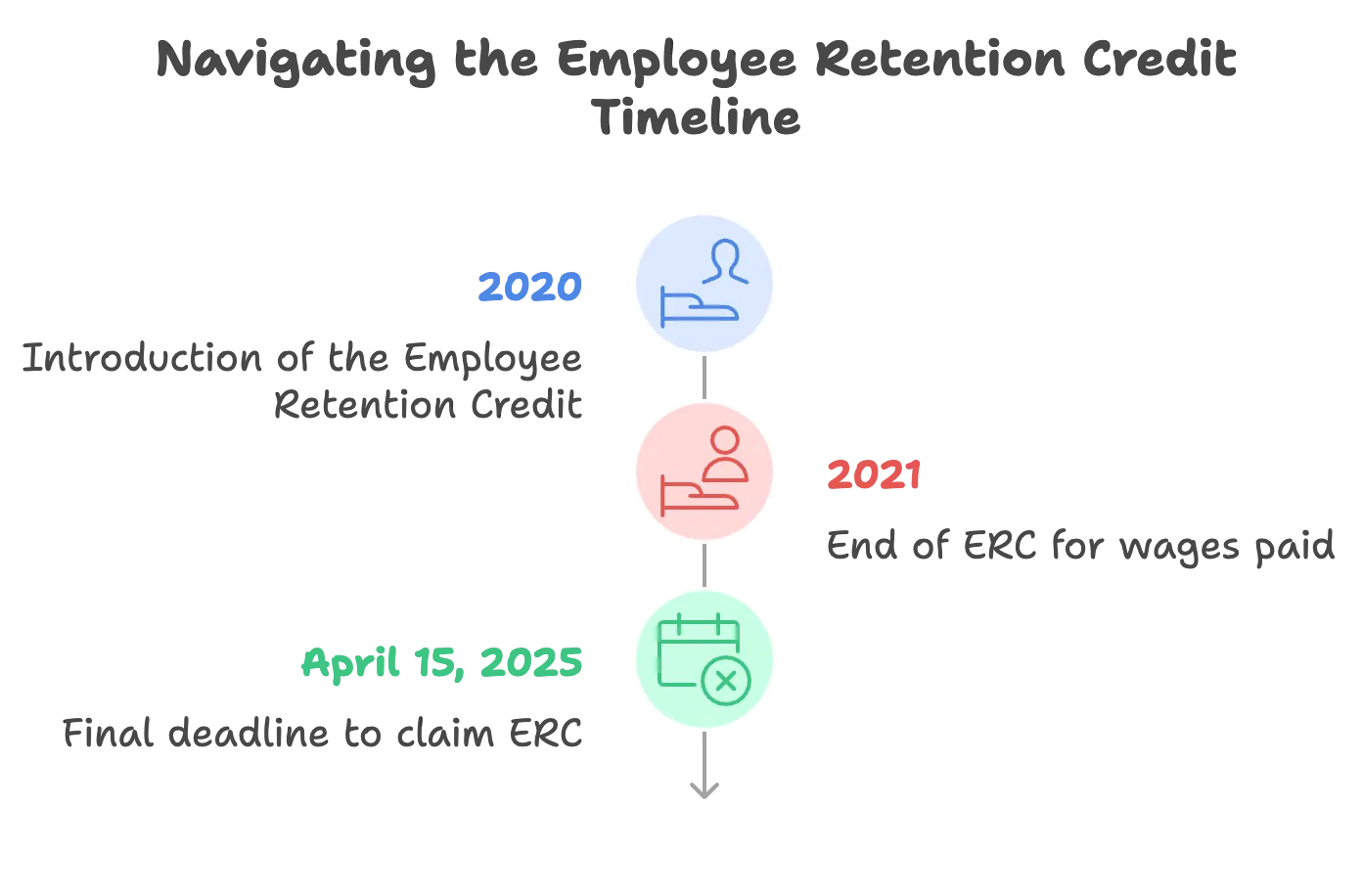
The Employee Retention Credit was introduced as part of the CARES Act in 2020 to help businesses retain employees during the economic uncertainty caused by the COVID-19 pandemic. This refundable tax credit is available to eligible employers that retained employees during specific periods in 2020 and 2021. By offsetting payroll taxes, the ERC provides a significant financial boost to qualifying businesses, potentially amounting to tens or hundreds of thousands of dollars in refundable credits.
The ERC is based on a percentage of qualified wages paid to employees during eligible quarters. While the program ended for wages paid after 2021, businesses still have the opportunity to retroactively claim the ERC by amending payroll tax filings—but only until the ERC deadline of April 15, 2025. Missing this deadline means losing the ability to claim this credit altogether.
Claiming the Employee Retention Credit on Your Own
The Employee Retention Credit can be claimed independently by making retroactive amendments to your payroll taxes. A good starting point for understanding the credit is IRS Notice 2021-20, which provides detailed guidance. However, calculating the specific credit amount and meeting the eligibility requirements involves dozens of variables and a complex web of rules.
If you choose to claim the ERC on your own, it will likely take 5 to 12 weeks to fully understand the credit and its requirements. The eligibility criteria are nuanced, involving revenue decline tests, operational suspension tests, and specific rules regarding qualified wages. Misinterpreting even one of these rules could lead to an incorrect filing and potential denial of your credit.

At The Relief Consultants, our team undergoes a three-month training program to master all aspects of the ERC before assisting business owners. This rigorous preparation ensures our consultants are well-versed in every nuance of the program, giving you peace of mind that your claim is accurate and maximized.
Attempting to claim the ERC yourself without a clear understanding of the process may result in delays, missed opportunities, or outright denial. While it is possible, you’ll need to assess whether you have the time and resources to commit to the task. If you’re busy managing your business, learning the ins and outs of the tax credit will be an uphill challenge.
Using a Firm to Claim the Credit
Using a professional firm to claim the Employee Retention Tax Credit is often the most efficient and reliable option. However, not all firms are created equal. Here’s what to look for:
- Comprehensive Qualification Testing: Ensure the firm conducts thorough eligibility checks. Some firms shortcut the process, filing claims with inflated amounts in hopes the IRS won’t catch the discrepancies—an approach that could expose you to audits or penalties.
- Experience and Expertise: A trusted firm like The Relief Consultants has a proven track record, backed by trained consultants who understand the intricate rules of the ERC program. Our team’s specialized training ensures that your claim will meet all IRS guidelines.
- Documentation and Transparency: Choose a firm that provides detailed documentation to support your claim. Avoid firms that fail to maintain clear records or rely on vague estimates. Proper documentation is essential for surviving a potential IRS audit.
- End-to-End Support: Look for a firm that handles the entire process, from determining eligibility to filing the claim and responding to IRS inquiries. This ensures you’re supported every step of the way.
By choosing a firm with the right expertise, you can save time, reduce risks, and maximize your refund. The Relief Consultants offer all of these benefits, providing you with the confidence that your claim will be accurate, complete, and fully compliant.
How to File for the ERC in 2025
Preparing Documents to Expedite the ERC Process
If you decide to work with a firm to claim the Employee Retention Tax Credit, having the following documents ready will streamline the process:
1. Payroll Detail Report
This key report lists all checks sent to employees from March 13, 2020, to December 31, 2021. Obtain this from your payroll software. If you used multiple payroll providers during this period, you’ll need reports from each.
For step-by-step instructions from major payroll software providers like ADP, QuickBooks Online, Gusto, and Paychex, visit this specifically designed step-by-step web page which covers instructions for most major Payroll Software Providers on how to generate your payroll detail report for the ERC.
2. Quarterly Revenue Information
This data is used to conduct the Revenue Decline Test. Gather gross receipts (not net profit) for all 12 quarters from 2019, 2020, and 2021. These numbers are typically found on quarterly Profit & Loss statements. Having accurate revenue data is critical for determining eligibility and ensuring your claim is accurate.
3. Form 941 Quarterly Payroll Tax Reports
Collect your Form 941s for the following periods:
- 2020: Quarters 2, 3, and 4
- 2021: Quarters 1, 2, 3, and 4
These reports are available in your payroll tax software and provide essential information about wages and taxes paid.
4. Documentation for Operational Suspension
If your business experienced a full or partial suspension of operations due to government orders during the pandemic, gather any relevant documentation to support your claim. This could include government directives, industry-specific mandates, or other evidence demonstrating the impact on your operations.
Having these documents ready will allow a firm to quickly assess your eligibility for the ERC. While additional information may be required depending on your specific circumstances, these reports will provide 90% of the necessary data.
The IRS ERC Moratorium
Due to an overwhelming amount of claims and the ineligible claims submitted by bad actors, the IRS imposed an ERC processing moratorium on September 14, 2023. This moratorium lasted nearly one year, with effectively no claims being processed from September 2023 to September 2024. In September 2024, however, the moratorium was lifted, and new claims were finally processed.
The moratorium created significant financial challenges for many businesses that had planned to receive their ERC funds within the typical three-month processing period. Processing times are now expected to take longer. However, because the ERC is a law written by the United States Congress, claims that meet eligibility criteria must be processed. While delays are possible, valid claims cannot be denied outright due to the moratorium.
Businesses should not let the moratorium discourage them from filing their Employee Retention Credit claims. Delays in payment are inconvenient, but the potential financial benefits of the ERC far outweigh the waiting period. If your business qualifies, filing as soon as possible ensures you’re in the queue for processing.
Why Start Now?
The deadline to claim the Employee Retention Tax Credit is April 15, 2025. At the time of writing, this leaves just over 100 days. The process generally takes 1–2 weeks if all required documents are available, so starting now is crucial.
Waiting until the last minute can result in rushed filings, incomplete documentation, and missed opportunities to maximize your credit. Don’t let procrastination cost you thousands of dollars in refunds—start gathering your documents and working with a trusted firm today.
The Relief Consultants’ Expertise
Since 2020, The Relief Consultants have been dedicated to helping business owners secure refunds from state governments, the IRS, and other grants and credits. Our team has worked closely with the IRS on the Employee Retention Credit (ERC) program since 2022, establishing a reputation as leaders in this space.
Under the leadership of Chris Gitre, Founder & CEO, The Relief Consultants have focused on making the ERC accessible and impactful for business owners across industries. We’ve helped hundreds of businesses recover millions of dollars in refundable credits, and we’re ready to do the same for you.
Take Action Today
For personalized assistance, contact The Relief Consultants and let our team of experts handle the complexities, so you can focus on growing your business. Don’t wait until it’s too late—schedule a call today and get your claim in before the April 15, 2025 deadline.
ERC IRS Frequently Asked Questions (FAQs)
1. What is the Employee Retention Credit (ERC)?
The ERC is a refundable tax credit for businesses that retained employees during the COVID-19 pandemic. It offsets payroll taxes and is based on a percentage of qualified wages paid during eligible periods in 2020 and 2021.
2. Can I still claim the ERC in 2025?
Yes, you can retroactively claim the ERC by amending payroll tax filings. However, the deadline to file for the credit is April 15, 2025.
3. How do I know if my business qualifies for the ERC?
Qualification depends on factors such as revenue decline, operational suspension due to government orders, and the wages paid to employees during the eligibility period. A professional firm can help you assess eligibility.
4. What documents do I need to claim the ERC?
Key documents include Payroll Detail Reports, Quarterly Revenue Information, Form 941 Quarterly Payroll Tax Reports, and documentation for operational suspensions (if applicable).
5. How long does it take to file an ERC claim?
If all documents are prepared, the process typically takes 1–2 weeks. However, learning the requirements and gathering documents may take longer if filing independently.
6. Can I claim the ERC on my own?
Yes, but the process is complex and time-intensive. It may take 5–12 weeks to fully understand the credit and prepare a claim accurately. If you need application assistance, the Relief Consultants can assist you in learning more about how to claim.
7. Why should I use a firm like The Relief Consultants?
Using a professional firm ensures accurate claims, maximized refunds, and compliance with IRS rules. The Relief Consultants’ team has extensive training and experience in handling ERC claims.
8. What happens if I file an incorrect ERC claim?
Filing an incorrect claim can lead to delays, audits, or penalties. It’s essential to follow all IRS guidelines and provide accurate documentation.
9. How much can my business receive through the ERC?
The exact amount depends on qualified wages, the number of employees, and eligibility criteria. Businesses may be eligible for tens or hundreds of thousands of dollars in refundable credits.