

Findings & Insights from The Relief Consultants’ Founder, Chris Gitre
On September 14th, the IRS announced a significant moratorium on the Employee Retention Credit (ERC), adding uncertainty to the timeline of many businesses’ ERC claims. The moratorium heralds two pivotal changes: an increased processing time for claims filed prior to September 14th and a complete halt on claims processing for submissions made on or after this date until January 1st, 2024.
Since the announcement, The Relief Consultants have engaged with numerous IRS agents and meticulously tracked all ERC-related communications from government channels. Our findings present the following:
The Current State of ERC Claims Processing
It’s clear that the IRS has temporarily ceased processing ERC claims. Not a single client has reported receiving their anticipated refund since the moratorium’s commencement. This halt is in contrast to the IRS’s initial intimation that only processing times would lengthen. The Relief Consultants perceive this as misleading, as the current situation is not a mere delay but a complete cessation of claim processing.
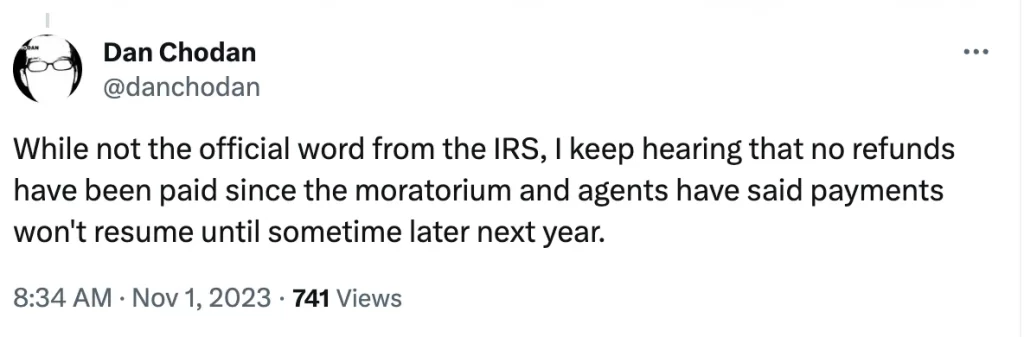
on X.com, user @danchodan leads the way about providing material updates to the ERC
Our analysis suggests that the IRS may be developing advanced fraud detection methods, possibly leveraging technology to automate the rejection of spurious claims. This endeavor could potentially streamline the process, swiftly filtering out illegitimate claims and advancing valid ones for further examination.
One method for detecting fraudulent activity could involve analyzing the ratio of ERC credit to wages reported on Employer Quarterly Tax Filings (Form 941s). IRS representatives have hinted at disqualifying claims that surpass an “expected credit,” based on a preset percentage of declared wages.
Additionally, we’ve learned that the IRS might scrutinize claims where the authorized signer on the 941x form lacks a prior association with the business tax account. While this could be an effective audit tool, it may inadvertently delay legitimate claims from businesses with new financial officers.
While the IRS’s complete plans to safeguard the integrity of taxpayer funds remain unclear, it is evident that they are fortifying their defenses against fraud. The full resumption of ERC claim processing is likely contingent on the successful implementation of these new measures.
The Wisdom of Submitting ERC Claims During the Moratorium
Despite the moratorium, The Relief Consultants stand by the wisdom of continuing to submit ERC claims, provided they are legitimate. Echoing sentiments from the IRS Tax Professional Webinar regarding the Moratorium, the Director of the ERC program ensured that submissions during this period will secure a place in the processing queue once the IRS resumes its operations.
Contrary to the shocking (and concerning) advice of some IRS phone agents and one representative of an uninterested PEO, suggesting that submitting before 2024 is useless, we believe in the simple logic of queuing: to receive something valuable, one must be in line for it.
The Future of the ERC Program
The ERC, being encoded in law, is not subject to arbitrary changes by the IRS; only an act of Congress could curtail the program prematurely. Recent inquiries from the House Ways and Means Committee to IRS Commissioner Werfel have begun the conversation of legislative action related to the ERC. However, it seems unlikely that Congress would risk public censure by ending a relief program that many American businesses could receive yet still have still not applied for.
It is more plausible to anticipate legislative changes surrounding the practices of tax preparers and promoters involved with ERC filings, potentially including fee limitations or required certifications.
Weeding out the Bad Apples
The repercussions of the ERC moratorium on some ERC firms are quite telling. As a major player in the ERC claims processing sector, Innovation Refunds (IR) was notably impacted almost immediately following the announcement of the moratorium. Within a mere 48 hours, IR laid off half of their workforce. This reduction was a direct response to the anticipated slowdown in the processing and approval of claims due to the IRS’s warning message.

IR CEO Howard Makler made substantial changes to his company mere hours after the “IRS Moratorium”
Prior to the moratorium, IR’s operations were expansive, with a significant advertising presence aimed at promoting their expertise in securing ERC funds for businesses. The moratorium, with its increased scrutiny and pause on claim processing, likely frightened IR leadership. The ripple effect on IR’s business was substantial, leading not only to staff reductions but also a complete halt to their advertising initiatives, effectively scaling down their public footprint.
Our internal interviews with former IR employees, and the subsequent onboarding of a skilled team member from their ranks, revealed that while IR’s calculation methods for filings appeared to be correct, their criteria for qualifying companies — particularly under the “Partial Shutdown due to Governmental Order Rule” — were overly generous. The moratorium has opened the door for scrutiny on substantiation, which Innovation Refunds, and firms alike, were failing to provide bona-fide eligibility verification for their clients. The end to various aspects of IR’s operations will occur in courtrooms.

One Reddit User opines that Innovation Refunds is in serious trouble
Impact on a Prominent ERC Promoter
Another significant effect of the moratorium was observed in the case of a prominent ERC promoter, who, in the face of the moratorium’s crackdown, ceased operations in the ERC space and pivoted to other government-related activities. This particular promoter was known for a successful referral partner program, which recruited individuals to act as a marketing funnel for potential claims. The moratorium effectively uprooted this business model by causing headaches for the promoter, ultimately persuading him to move on from the ERC.
The shutdown of this promoter’s ERC-related activities is indicative of a broader trend where the moratorium served as a filter, weeding out entities whose operations may not have been in full compliance with the many rules of the ERC.
In Conclusion
The moratorium’s inception has likely accomplished two things: it has provided the IRS with a period to refine procedures for better fraud detection and served as a cautionary signal to those engaged in substandard practices.
The complexities of the ERC are daunting, and more could be done by the IRS to elucidate the code for the public. Nevertheless, the moratorium marks a commendable stride towards eliminating unscrupulous entities from the ERC processing ecosystem.
In conclusion, while The Relief Consultants eagerly anticipate the return of normal processing operations, we view the moratorium as a critical juncture. It represents an opportunity for the IRS to enhance the integrity and efficacy of the ERC claim process. As the landscape evolves, we remain committed to guiding businesses through legitimately filing their claims with the expertise and insight that has become our hallmark.
Leave a Reply